12 Best Node.js Development Companies in the USA
A vetted list of the twelve best Node.js development companies in the USA in 2026 with office locations, client portfolios, and hourly rate ranges. Covers boutique agencies, mid-size shops, and offshore-blend firms with US presence. Useful for procurement teams shortlisting partners for a Node.js backend or full-stack project.
Finding a Node.js development company that actually delivers is harder than it looks. The market is crowded, quality varies enormously, and the difference between a great partner and a costly mistake often isn't visible until you're months into a project. This guide cuts through the noise — we reviewed over 200 Node.js agencies, analyzed real client outcomes, and selected the 12 firms that consistently build scalable, high-performance applications in 2025.
Our criteria were strict: each company needed a verified track record of 200+ Node.js projects, consistent 4.7+ client ratings across multiple platforms, transparent pricing, and demonstrable technical depth across frameworks like Express.js, Nest.js, and Koa.
Why Node.js Dominates Modern Web Development
Before evaluating companies, it's worth understanding why Node.js has become the dominant choice for modern web applications. Node.js can reduce server response times by up to 50%, handles thousands of concurrent connections with minimal resource overhead, and enables the same language — JavaScript — across your entire stack. These aren't marginal gains. They translate directly into lower infrastructure costs, faster development cycles, and better user experiences.
Key technical advantages of Node.js:
Event-Driven Architecture: Node.js processes thousands of concurrent connections using a single-threaded, non-blocking event loop — instead of spawning an expensive new thread per request. This means your application stays responsive under heavy load without requiring proportional infrastructure scaling.
JavaScript Everywhere: Frontend and backend teams share a single language, reducing context-switching, simplifying code reviews, and making full-stack developers genuinely productive across your entire codebase. This alone can cut hiring complexity significantly.
Native Real-Time Capabilities: Chat systems, collaborative editors, live dashboards, and multiplayer applications all benefit from Node.js's event-driven design. Real-time features are built into the architecture — not retrofitted — which means cleaner code and more reliable behavior under concurrent user load.
Massive Ecosystem: With over 2 million packages on npm, Node.js developers rarely build foundational functionality from scratch. Authentication, caching, payment processing, file handling — robust, battle-tested solutions exist for virtually every requirement, dramatically accelerating development timelines.
Proven at Enterprise Scale: Netflix, LinkedIn, Uber, and PayPal all run critical systems on Node.js — not because it was fashionable, but because it demonstrably reduces infrastructure costs while handling millions of concurrent users. LinkedIn's mobile backend migration to Node.js cut their server count from 30 to 3 while doubling traffic capacity.
For most modern web applications — especially those involving real-time features, high concurrency, or API-first architectures — Node.js is an excellent foundation. The more pressing question is selecting the right development team to build on it properly.
How We Evaluated These Node.js Development Companies
Every company on this list was measured against the same five-point framework. No paid placements, no sponsored rankings — only firms that cleared the bar on all criteria:
Proven Delivery Track Record: A minimum of 200 completed Node.js projects with verifiable client outcomes. Longevity matters too — companies with 8+ years of consistent delivery demonstrate they can weather technology changes and business cycles.
Technical Depth Across the Stack: Fluency in key Node.js frameworks (Express.js, Nest.js, Koa, Hapi), microservices architecture, WebSocket implementations, RESTful and GraphQL API development, and cloud deployment across AWS, Google Cloud, and Azure.
Verified Client Satisfaction: Ratings of 4.7 or higher across multiple independent review platforms (Clutch, G2, GoodFirms), with consistent patterns rather than isolated five-star reviews. Companies with a few glowing testimonials but thin review histories were excluded.
Transparent Pricing: Every company here publishes clear hourly rates and minimum project sizes. Hidden fees, bait-and-switch pricing, or refusal to provide ballpark estimates before an initial consultation were all disqualifiers.
Relevant Industry Specialization: General competence isn't enough. We tracked which companies have genuine depth in specific verticals — FinTech, healthcare, eCommerce, SaaS, and real-time applications — so you can match agency expertise to your actual project type.
The result is a shortlist of twelve companies that cleared every bar — each representing genuinely elite Node.js development capability in 2025.
Quick Comparison: Top 12 Node.js Development Companies
| Company | Rating | Min. Project | Hourly Rate | Experience | Best For |
|---|---|---|---|---|---|
| Monocubed | 4.9/5 | $25,000+ | $100-$149/hr | 6 years | Real-Time Apps, SaaS |
| BairesDev | 4.9/5 | $50,000+ | $50-$99/hr | 15 years | Enterprise Solutions |
| TechMagic | 4.8/5 | $25,000+ | $50-$99/hr | 10 years | Startups, MVPs |
| Netguru | 4.8/5 | $25,000+ | $50-$99/hr | 15 years | Collaboration Tools, IoT |
| Swiftspeed | 4.8/5 | $15,000+ | $25-$49/hr | 12 years | Mobile + Web, Healthcare |
| Zazz | 5.0/5 | $50,000+ | $50-$99/hr | 13 years | Sports Apps, Media |
| Vention | 4.9/5 | $25,000+ | $50-$99/hr | 22 years | SaaS, Enterprise |
| Bilberrry | 5.0/5 | $25,000+ | $50-$99/hr | 14 years | eCommerce, Consumer Apps |
| Scopic | 4.9/5 | $5,000+ | $25-$49/hr | 18 years | EdTech, Cost-Effective |
| Azumo | 4.8/5 | $50,000+ | $75-$125/hr | 9 years | Nearshore Teams, AI |
| Rootstrap | 4.8/5 | $50,000+ | $100-$150/hr | 13 years | ML/AI Integration |
| Brainhub | 4.8/5 | $25,000+ | $50-$99/hr | 9 years | Digital Acceleration |
The 12 Best Node.js Development Companies (In-Depth Analysis)
1. Monocubed
Monocubed has earned a reputation as a premier Node.js consultancy through a portfolio of complex, high-scale systems. Founded in 2013 and holding a 4.9-star Clutch rating, the company brings architectural discipline to every engagement — not just code delivery.
Where many agencies hand over code and leave, Monocubed designs systems built to evolve. Their architects plan for horizontal scaling and performance bottlenecks from day one, which pays dividends when your user base grows 10x. This long-term thinking is especially valuable for SaaS platforms and real-time products where architecture mistakes become expensive rewrites.
Core Services:
- Real-time application development (chat, collaboration tools, live updates)
- Scalable SaaS platform architecture
- Microservices implementation
- API development and integration
- Cloud-native applications (AWS, Google Cloud, Azure)
Technical Strengths: Developers averaging 8+ years of Node.js experience, with AWS Solutions Architect and Google Cloud Professional certifications. Deep expertise in Express.js and Nest.js frameworks, WebSocket-based real-time systems, and event-driven microservices architectures.
Ideal For: Startups and scale-ups building real-time SaaS platforms, companies that need architectural guidance alongside development, and businesses planning for significant user growth.
Notable Achievement: Delivered a real-time collaboration platform sustaining 50,000+ concurrent WebSocket connections with 99.9% uptime and sub-100ms latency — infrastructure most agencies would struggle to architect correctly.
2. BairesDev
BairesDev markets itself as "the top 1% of tech talent" — a claim that's difficult to audit in isolation, but their portfolio makes a strong case. Enterprise clients including Rolls-Royce, Motorola, and Adobe have trusted them with mission-critical Node.js systems, and their 4.9-star rating reflects consistent delivery at the senior end of the market.
BairesDev specializes in assembling dedicated Node.js teams that integrate directly into your existing engineering organization. Their strength is in augmenting in-house teams with genuine senior talent rather than assigning junior developers at senior rates — a common agency practice that BairesDev's rigorous 1% acceptance hiring process is designed to prevent.
Core Services:
- Enterprise Node.js application development
- Microservices architecture and migration
- Real-time chat and messaging systems
- eCommerce platform backends
- Staff augmentation and dedicated teams
Technical Strengths: Comprehensive backend expertise spanning distributed systems design, database optimization (MongoDB, PostgreSQL, Redis), message queue architectures (RabbitMQ, Kafka), and container orchestration (Docker, Kubernetes). Their developers approach Node.js as a piece of a larger systems problem — not an isolated technology.
Ideal For: Large enterprises and well-funded startups that need senior-level Node.js engineers who can own complex architectural challenges. Best suited for companies willing to invest in quality rather than minimize upfront cost.
Why They Stand Out: Their hiring process accepts only the top 1% of applicants, ensuring clients actually work with senior engineers — not mid-level developers promoted to senior roles to justify billing rates.
3. TechMagic
TechMagic has built a strong reputation in the startup ecosystem for shipping production-ready MVPs without accumulating the technical debt that typically forces costly rewrites six months later. Based in Poland with a decade of Node.js experience and a 4.8-star rating, their sweet spot is early-stage products that need to be both fast to market and structurally sound.
Most agencies either move fast and leave you with fragile code, or move carefully and miss your launch window. TechMagic has refined a process that genuinely does both — building architecture that doesn't require a full rewrite when you scale from 1,000 to 100,000 users. For funded startups under time pressure, this is a meaningful differentiator.
Core Services:
- MVP development with Node.js
- Real-time application development
- SaaS platform architecture
- Third-party API integration
- Technical consulting and architecture review
Technical Strengths: Deep expertise in WebSocket-based real-time applications, data-intensive SaaS platforms, and third-party API integrations. Notably, TechMagic applies microservices architecture selectively — matching complexity to actual project needs rather than applying the same pattern to every engagement.
Ideal For: Seed-to-Series A startups building MVPs, product teams requiring real-time features, and companies seeking competitive European development rates without sacrificing quality.
Notable Work: Built a real-time news platform capable of handling millions of concurrent readers with sub-second article updates and live commenting — a demanding combination that requires careful WebSocket and database architecture.
4. Netguru
Netguru is one of Europe's most experienced Node.js agencies, with 15 years of delivery history, 2,500+ completed projects, and an impressive client roster that includes IKEA, OLX, and Volkswagen. Their team of 400+ professionals operates across development, product design, and project management — making them one of the few agencies that can genuinely own a full product build.

Netguru's strongest differentiator is breadth without sacrificing depth. They handle product strategy, UX design, Node.js development, and post-launch optimization under one roof. If you're building a product where technical and product decisions are tightly coupled — IoT platforms, collaborative tools, enterprise dashboards — this integrated approach significantly reduces coordination overhead.
Core Services:
- Enterprise Node.js development
- IoT platform development
- Collaboration tools and real-time apps
- Microservices architecture
- Mobile app backends
Technical Strengths: Expert-level microservices architecture enabling independent scaling of system components, lightweight high-performance API development, and IoT platform engineering. Their agile processes are genuinely transparent — stakeholders always know sprint status, blockers, and upcoming milestones.
Ideal For: Companies that need a single partner covering product strategy, UX design, and Node.js development; IoT platform builds; enterprise collaboration tools; and businesses that want hands-on project management rather than code-and-invoice delivery.
Agile Excellence: Netguru's sprint-based processes include weekly stakeholder updates and direct access to developers — not just account managers. Scope changes get discussed early rather than surfacing as surprise invoices at project close.
5. Swiftspeed Technologies
Swiftspeed Technologies has delivered 300+ projects since 2010, with a specialized focus on Node.js backends that power both web and mobile applications simultaneously. Based in Tempe, Arizona, their client list includes Nike, McAfee, and Walmart — brands with demanding technical requirements and zero tolerance for downtime.
Swiftspeed's full-stack capability solves a coordination problem that trips up many development projects: the backend and mobile teams are different vendors with different timelines and communication styles. By owning the entire ecosystem — Node.js backend, web frontend, and mobile app — Swiftspeed eliminates integration friction and delivers more cohesive products.
Core Services:
- Node.js backend for mobile apps
- Real-time web applications
- eCommerce platform development
- Healthcare applications (HIPAA-compliant)
- B2B and B2C platforms
Technical Strengths: A team of 50+ Node.js specialists across Express.js, Koa, and Hapi frameworks, with Socket.io expertise for real-time feature implementation. The team includes Certified Scrum Product Owners ensuring agile delivery stays on track, and has dedicated HIPAA compliance experience for healthcare applications.
Ideal For: Companies building integrated mobile and web products, healthcare startups that require HIPAA compliance built in from the start, and eCommerce platforms needing robust backend infrastructure.
Notable Achievement: Built a HIPAA-compliant healthcare platform processing over 100,000 patient appointments monthly — with real-time scheduling updates and zero compliance incidents since launch.
6. Zazz
Zazz holds a rare perfect 5.0-star rating on Clutch across a substantial number of reviews — an achievement that's far harder to maintain than to achieve initially. Founded in 2011 with clients including the NBA, KPMG, and Roku, they have particularly strong credentials in sports technology and media platforms where real-time performance is non-negotiable.
Most development agencies treat post-launch support as an afterthought or a separate retainer. Zazz builds ongoing support and performance monitoring into every engagement from the start — which is a significant advantage for applications where uptime directly affects revenue, such as live sports scoring platforms or streaming services.
Core Services:
- Custom Node.js application development
- Sports and media platforms
- Real-time data processing
- API development
- Mobile app backends
Technical Strengths: Specialized expertise in real-time data applications, live sports platforms, and media streaming systems. Their team is adept at building Node.js architectures that handle unpredictable traffic spikes — the kind that occur during live events when tens of thousands of users connect simultaneously.
Ideal For: Sports technology and media companies, businesses building live event platforms, and organizations that prioritize long-term application health over just hitting launch day.
Client Commitment: A perfect rating maintained over 13+ years of operation signals genuine consistency — not just a good run. Zazz's communication practices and realistic timeline management are cited repeatedly in client reviews as key differentiators.
7. Vention
With 22 years of operating history, 3,000+ engineers across 20+ global offices, and a 4.9-star Clutch rating, Vention is one of the most resource-rich Node.js firms available. Their client portfolio includes Costa Coffee and major enterprises across finance, healthcare, and logistics.
Vention's primary advantage is scale and speed of assembly. If you need to expand your Node.js team by 10 engineers in 30 days — a scenario where traditional hiring fails — Vention can staff the team immediately with pre-vetted talent. This makes them particularly valuable for companies in rapid growth phases or managing large-scale system migrations.
Core Services:
- Enterprise SaaS platforms
- Scalable backend architecture
- Microservices implementation
- Real-time applications
- Cloud-native development
Technical Strengths: Full-stack Node.js expertise spanning Express.js for traditional web applications to Nest.js for enterprise-grade structured architectures. Strong capabilities in event-driven system design, microservices implementation, and cloud-native development across all major cloud providers.
Ideal For: Enterprises needing to scale engineering teams rapidly, SaaS companies with unpredictable resourcing needs, and businesses running large-scale system transformations that require specialized Node.js expertise across multiple work streams.
Scale Advantage: With 3,000+ engineers on their network, Vention can fill specialized team gaps — senior Node.js architects, real-time systems experts, DevOps engineers — with a speed that no traditional recruitment process can match.
8. Bilberrry
Bilberrry has earned a perfect 5.0-star Clutch rating while delivering for clients including PepsiCo, the University of Washington, and Delta. Founded in 2010 and headquartered in Seattle, their reputation centers on rigorous code quality and a collaborative process that keeps clients genuinely informed rather than just updated.
The most common complaint about development agencies is discovering problems too late to fix them cheaply. Bilberrry addresses this through weekly stand-ups, continuous code reviews, and structured feedback loops built into every sprint. By the time a feature ships, it's been reviewed multiple times — not just tested at the end.
Core Services:
- Custom eCommerce platforms
- Consumer-facing applications
- Real-time features implementation
- Mobile app backends
- API development and integration
Technical Strengths: Performance optimization built into every layer of development — not bolted on after the fact. Their cross-functional teams (developers, strategists, designers) collaborate from the initial architecture phase, which produces more coherent products than siloed hand-offs between departments.
Ideal For: eCommerce platforms with high transaction volume, consumer-facing applications where performance directly impacts revenue, and companies that want genuine collaboration rather than a vendor-client relationship.
Quality Focus: Every feature goes through multiple code reviews before merging, and every release runs through comprehensive testing. The result is lower post-launch defect rates and faster iteration once the application is live.
9. Scopic
Founded in 2006, Scopic has 18 years of Node.js delivery experience and 1,000+ completed projects — a track record that reflects genuine longevity, not just marketing claims. Their 4.9-star rating demonstrates that accessible pricing and quality work aren't mutually exclusive.
Scopic's standout characteristic is democratizing access to professional Node.js development. A $5,000 minimum project size puts serious development work within reach for bootstrapped startups and growing businesses that can't absorb the $25,000+ minimums charged by premium agencies. The $25–$49/hour rate delivers enterprise-quality architecture at a price point most early-stage companies can actually afford.
Core Services:
- Educational technology platforms
- Real-time collaboration tools
- Progressive web apps (PWAs)
- API development
- Scalable web applications
Technical Strengths: Architecture-first development focused on building systems that scale efficiently without requiring expensive infrastructure overhauls as user volume grows. Strong EdTech platform experience and progressive web app (PWA) expertise.
Ideal For: EdTech platforms, budget-conscious startups, mid-sized businesses that need production-quality Node.js work without premium agency pricing, and companies prototyping new products before committing to full-scale development.
Value Proposition: At $25–$49/hour with an 18-year delivery track record, Scopic offers one of the strongest quality-to-cost ratios in the Node.js development market — particularly for projects in the $5,000–$50,000 range where premium agencies either don't engage or charge rates that don't align with early-stage budgets.
10. Azumo
Azumo provides nearshore Node.js development teams from Latin America — a model that offers the timezone alignment and English fluency of US-based development at 30–40% lower cost. Founded in 2016 with a 4.8-star rating, their focus is on building dedicated teams that integrate with client workflows rather than operating as a disconnected offshore vendor.
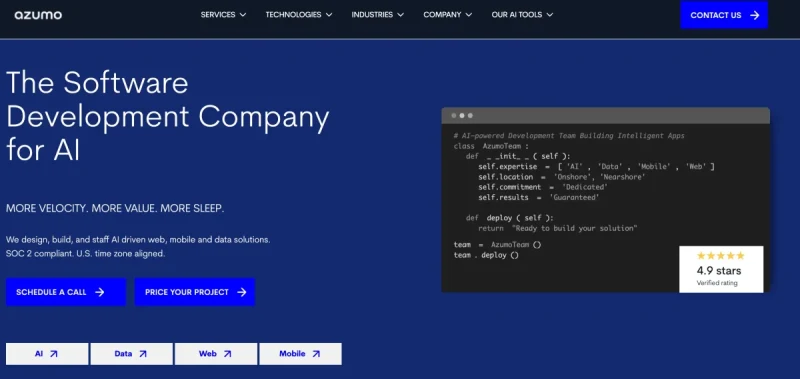
Offshore development's persistent failure modes are predictable: timezone gaps that slow decision-making, communication friction that causes specification drift, and cultural misalignments that create friction throughout the project. Azumo's nearshore model directly addresses all three — Latin American developers overlap with US business hours, enabling real synchronous collaboration rather than async message threads.
Core Services:
- Custom Node.js development
- AI-powered application development
- Real-time systems
- Microservices architecture
- Dedicated development teams
Technical Strengths: Current with emerging technology integration, particularly AI-enhanced Node.js applications. Deep understanding of serverless architectures, containerized deployments, and event-driven design patterns that are increasingly central to modern application development.
Ideal For: US-based companies seeking nearshore development that maintains real-time collaboration, AI-augmented application projects, and businesses that need dedicated teams with genuine timezone compatibility.
Nearshore Advantage: A 4–6 hour daily overlap with US time zones makes Azumo's teams functionally indistinguishable from onshore talent during business hours — at 30–40% lower cost. This is the model's core value proposition, and it's genuine.
11. Rootstrap
Rootstrap has earned recognition on both the Financial Times Americas' Fastest-Growing Companies and INC 5000 lists — markers of sustained business growth that reflect genuine client demand. Founded in 2011, they specialize in Node.js development with deeply integrated machine learning and AI capabilities for teams at MasterClass, Google, Salesforce, and Universal Music Group.
Rootstrap's distinguishing characteristic is the intersection of Node.js expertise with genuine AI/ML capability — not buzzword integration, but practical systems that use machine learning to deliver measurable product improvements. If your application roadmap includes recommendation engines, predictive analytics, or intelligent automation, Rootstrap brings depth that generalist Node.js agencies simply don't have.
Core Services:
- Node.js application development
- Machine learning integration
- AI-powered features
- Data science and analytics
- Product strategy consulting
Technical Strengths: Integrated AI/ML implementation alongside Node.js backend development — including recommendation systems, data pipelines, and predictive features. Strong DevOps practices with automated CI/CD pipelines and infrastructure-as-code ensure production stability and deployment confidence.
Ideal For: Companies building AI-integrated applications, data-driven platforms requiring recommendation or prediction capabilities, and startups that need both technical execution and strategic product guidance from a single partner.
Client Calibre: MasterClass, Google, Salesforce, and Universal Music Group represent the kind of high-stakes, high-visibility projects that separate agencies capable of enterprise delivery from those that just say they are.
12. Brainhub
Brainhub operates at the intersection of technology delivery and digital acceleration consulting. Their 4.8-star Clutch rating reflects a model focused on long-term client capability building rather than project-by-project deliverables — an approach that creates genuine value beyond the immediate engagement.
The most common complaint after a development project ends is that the internal team can't understand, extend, or maintain what was built. Brainhub directly addresses this through structured knowledge transfer — documenting architectural decisions, running technical workshops, and ensuring your engineers leave every sprint more capable than they entered it.
Core Services:
- Digital acceleration solutions
- Team augmentation
- Node.js application development
- Product strategy and consulting
- Technical workshops and training
Technical Strengths: Consultative architecture approach where developers actively explain their decisions rather than just implementing them. This creates teams that understand the codebase deeply — which matters enormously for long-term maintenance and feature velocity.
Ideal For: Companies scaling internal engineering teams and needing temporary Node.js expertise, organizations that want to genuinely upskill their own developers through engagement, and businesses seeking strategic technical consultancy alongside hands-on development.
Partnership Philosophy: Brainhub's explicit focus on cultural alignment reflects an understanding that development partnerships fail for human reasons as often as technical ones. Their discovery process includes evaluating team compatibility alongside technical requirements.
How to Choose the Right Node.js Development Company
Knowing the top options is necessary but not sufficient. The right company for a well-funded enterprise building a FinTech platform is almost certainly not the right company for a bootstrapped founder validating an MVP. Here's how to make a decision that fits your actual situation.
Match Your Budget to Your Business Stage
Budget-stage mismatches are one of the most common sources of project disappointment. A bootstrapped startup validating a concept has no business spending $150/hour — Scopic's $25–$49/hour rates can build that MVP without draining your runway. Conversely, trying to cut costs on a critical enterprise system rewrite with a budget agency is a false economy: the mistakes cost more to fix than the initial savings.
The principle: match agency tier to your risk exposure. Early-stage validation → budget-conscious agencies with solid track records. Scaling infrastructure → mid-tier specialists. Enterprise-critical systems → senior-only agencies with enterprise portfolios, even if the rate is higher.
Prioritize Relevant Technical Experience
Node.js is broad. Building a real-time chat system requires fundamentally different architecture expertise than constructing a high-throughput eCommerce backend. Streaming video infrastructure is a different discipline from RESTful API development. Domain-specific experience matters — an agency that has built five healthcare HIPAA-compliant platforms will make different (better) decisions than one doing compliance for the first time.
Use technical interviews to test depth. The questions below separate genuine experts from developers who've touched Node.js a few times:
- How do you handle WebSocket connections at scale?
- What's your approach to database selection for different use cases?
- How do you implement caching strategies for high-traffic applications?
- What's your experience with message queues and event-driven architectures?
Strong candidates provide specific, opinionated answers with trade-offs acknowledged. Vague responses, generic marketing language, or inability to discuss architectural decisions in concrete terms are reliable signals of limited depth.
Evaluate Communication and Project Management
Technical competence is necessary but not sufficient. Poor communication processes — slow responses, inconsistent information, unclear project management — compound over time and often create more damage than technical mistakes. Evaluate communication during the sales process: the behavior you see before signing a contract is generally better than what you'll see after.
Red flags include:
- Taking 3+ days to respond to straightforward questions
- Providing contradictory information between different team members
- Pressuring you to sign contracts before fully understanding requirements
- Unable to explain technical concepts in understandable terms
- Lack of established development processes
Green flags include:
- Asking detailed questions about business goals (not just technical specs)
- Providing realistic timelines instead of overly optimistic promises
- Explaining their agile/scrum processes clearly
- Offering paid discovery phases before full project commitment
- Transparent pricing with detailed breakdowns
Verify Portfolio and Technical Competence
Screenshots and case study PDFs tell you nothing about actual code quality. Request live URLs of production applications, then test them — run Google PageSpeed Insights, check how error states are handled, test real-time features under concurrent load if applicable. If an agency can't point you to live production work from the last two years, treat that as a significant concern.
For real-time features specifically, don't just review the demo. Open two browser windows simultaneously and test whether WebSocket updates propagate correctly, whether the system handles disconnection and reconnection gracefully, and whether notification delivery is reliable under normal usage — not just in a demo environment.
Reference calls should be with clients whose projects resemble yours in size, industry, and technical complexity. Ask specifically:
- Did the project stay on budget and timeline?
- How did the company handle unexpected challenges?
- What was the quality of communication throughout development?
- Would you hire them again for your next project?
One client who gives a detailed, candid reference — including what went wrong and how the agency handled it — is worth more than a dozen generic five-star testimonials. Agencies with nothing to hide are generally comfortable connecting you with multiple past clients.
Real-World Node.js Applications: What's Possible
Node.js excels in specific application types. Understanding where it performs best helps you confirm fit before committing to development — and helps you evaluate whether an agency's portfolio demonstrates genuine depth in your use case.
Real-Time Applications: Chat systems, collaborative editors, live dashboards, multiplayer games, and event-driven platforms all perform exceptionally well on Node.js. The event-driven architecture makes real-time features a natural fit rather than a complex integration — which translates into cleaner code, fewer edge-case bugs, and better performance at scale.
API Backends: RESTful and GraphQL APIs built on Node.js handle high request volumes efficiently due to its non-blocking I/O model. The lightweight runtime means lower infrastructure costs compared to thread-based alternatives — a meaningful advantage as request volume scales.
Streaming Applications: Node.js handles continuous data streams natively, making it ideal for video and audio streaming platforms. Netflix runs its UI serving layer on Node.js specifically because of this — managing millions of concurrent stream sessions efficiently.
eCommerce Platforms: High-traffic stores handling simultaneous inventory checks, cart updates, payment processing, and recommendation requests benefit significantly from Node.js's concurrent connection handling. Walmart and eBay both run customer-facing Node.js applications at scale.
IoT Platforms: Systems ingesting continuous data streams from thousands of sensors require exactly the concurrent, event-driven processing model that Node.js is built around. The ability to handle many simultaneous low-latency connections without thread overhead makes it a natural fit for industrial and consumer IoT applications.
Social and Community Platforms: Real-time notifications, live feeds, instant messaging, and high-concurrency comment systems all benefit from Node.js's architecture. LinkedIn's mobile backend runs entirely on Node.js — and their migration from Ruby on Rails resulted in a 20x reduction in response time.
Want to Prototype Before Full Development?
One consideration many product teams overlook: committing to a full custom development contract before validating core assumptions is an expensive way to learn. Building a functional prototype first — to confirm users actually want what you're building, and to sharpen your technical requirements before briefing an agency — can save substantial time and money.
Swiftspeed App Builder enables non-technical founders to build functional web application prototypes without writing extensive code. It's not a replacement for custom Node.js development on complex or high-scale projects, but it's purpose-built for several scenarios where jumping straight to a development agency may not be the right first step.
- Rapid prototyping before investing in full development
- Building internal tools and dashboards quickly
- Creating MVPs to validate app ideas
- Developing simple web apps and client portals
The drag-and-drop interface and pre-built templates enable product teams to build functional prototypes in days rather than months. When you subsequently brief a Node.js development agency with a working prototype, you get more accurate estimates, clearer technical requirements, and less risk of expensive specification changes mid-development.
Swiftspeed also supports teams that need to publish applications quickly, convert existing websites into apps, and build Android applications without traditional development overhead — useful for internal tools and early-stage products.
Going into your agency conversations with a clear prototype and validated concept doesn't just save money — it makes you a significantly better client. Agencies give clearer estimates, make better technical decisions, and deliver better outcomes when requirements are concrete rather than abstract.
Making Your Final Decision
You now have the companies, the evaluation criteria, and the application context. Here's a practical process for converting that knowledge into a confident hiring decision:
Build a focused shortlist: Based on your budget, industry, and technical requirements, select 3–4 companies from this list. More than four becomes logistically unwieldy; fewer than three limits your comparative perspective.
Request standardized proposals: Send each shortlisted company the same project brief and ask for a comprehensive response — timeline, cost breakdown, proposed team composition, technical approach, and identified risks. Comparing responses against the same brief reveals differences in thinking and diligence that surface conversations don't.
Interview technical leads directly: Insist on calls with the actual architects and senior engineers who will work on your project — not just account managers or business development teams. Ask the technical questions from the previous section. The quality of those answers will tell you more than any portfolio.
Verify references with targeted questions: Don't accept general endorsements. Speak directly with past clients about timeline adherence, how scope changes were handled, communication quality under pressure, and critically — whether they would hire the agency again for a follow-on project.
Reduce risk with a scoped first engagement: If you're considering a long-term or high-value relationship, structure the first contract as a bounded paid discovery phase or smaller feature build. This proves real-world delivery quality before you're fully committed.
Act on your due diligence: If you've done thorough evaluation and something feels off — inconsistent answers, communication gaps, pressure to sign before you're ready — those signals typically get worse after contract signing, not better. Trust what the process revealed.
The quality of your Node.js development partner shapes the trajectory of your product. The right agency brings technical depth, honest communication, and genuine investment in your success — they push back on bad ideas, surface risks early, and deliver systems that hold up under real-world conditions. The wrong agency burns through budget, creates technical debt, and leaves you with code that requires a full rewrite six months after launch.
Choose carefully — and apply the same rigor to this decision that you'd want your development agency to bring to your codebase.
Ready to move forward? Review the companies above, shortlist the ones that align with your budget and use case, and reach out to your top three. Most offer free initial consultations — use them to evaluate communication quality and technical thinking before any contractual commitment.
Every great Node.js application started with the right development partnership. You now have the information to find yours.